

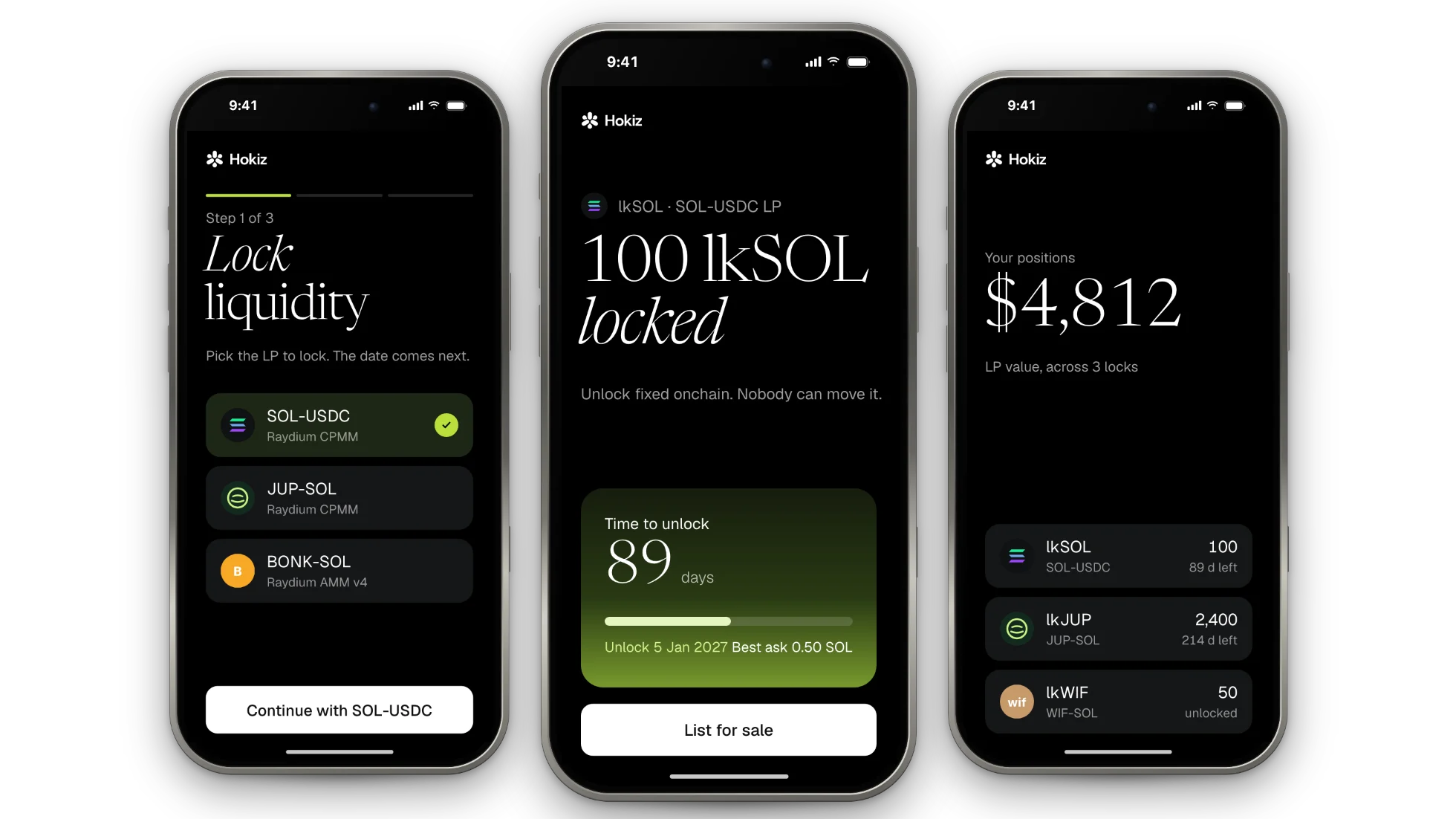
Owner-independent lock
Nobody can release a lock early or move its date — not the creator, not Hokiz, not a wallet holding the whole position. It is in the program.
Locked liquidity can earn swap fees for its entire term, but once it is locked, the owner normally loses access until expiry. Hokiz turns the claim on that locked liquidity into a transferable Solana token — so the lock doesn't move, but you can.
Lockers proved the liquidity can’t be pulled. Now the position can move.
Pick the pool
Any fungible LP on Solana: Raydium, PumpSwap, Meteora and more.

Fix the date at lock
Written onchain. The lock never moves — the position does.

A locker asks who owns the LP. Hokiz asks who owns the position.
| Unlocked LP | A normal locker | Hokiz | |
|---|---|---|---|
| Can it be pulled early | Any time | No, until the date | No, until the date |
| Who can move the date | There is no date | Sometimes the locker admin | Nobody. No instruction for it |
| What you hold | The LP token | A record in the locker | An SPL position token |
| Exit before unlock | Pull the liquidity | None | Send or sell, any slot |
| The fee stream | To the holder | Accrues, unreachable | Follows the position |
| Buying in later | Buy the pool tokens | Not possible | Buy from a holder |
How it works
Your LP tokens
Amount
Unlock date
Fixed onchain once you sign. No instruction moves it — for you, for Hokiz or anyone else.
Order book · lkSOL
Program rules hold the lock, not the owner.
LP in, position out. One unit per LP unit, minted once.
Burn the position for your share of the vault — fees included.
Send it, sell it or list it in the book. Zero fee.
No owner, admin unlock or instruction that moves the date.
lkSOL · SOL-USDC LP
Lock, receive, list, redeem — with the vault, the date and the order book readable onchain.

Nobody can release a lock early or move its date — not the creator, not Hokiz, not a wallet holding the whole position. It is in the program.
Vault balance, position supply and unlock date — for every lock, at any slot.
Legacy SPL Token or Token-2022. Concentrated-liquidity NFTs are not supported.
Traders. Every swap through the underlying pool can pay fees to its liquidity providers. Hokiz does not manufacture that yield: no fixed APY, no emissions, no treasury paying holders. If nobody trades, fee income can be zero.
You don’t exit the liquidity, you exit the position. Transfer or sell the SPL token and another wallet takes your place. The pool, the liquidity and the unlock date don’t change. A sale still needs a buyer; Hokiz makes the position transferable, it does not guarantee a bid.
No. Transferring the position changes who receives the LP at unlock, not when. The unlock timestamp is written at lock and enforced by the program; owning the entire position does not let anyone withdraw a slot early. Ownership is transferable. The lock isn’t.
Its underlying is the locked LP and the fees compounded into it, all readable from Solana. What someone pays for it is separate: accumulated fees, expected volume, time until unlock, pool risk and buyer demand. A long term left may mean a discount. Hokiz makes the lock liquid; it does not guarantee the price.
Before they’re locked, potentially. After they’re locked, that’s the problem: a locker hands back a record naming one wallet and one date. Hokiz changes that record into an SPL token. The custody, the term and the guarantee to everyone watching the chart are identical.
Yes. The position depends on the assets inside the pool: price movements, token risk, divergence loss and the economics of the AMM. Fees compensate LPs; they don’t guarantee profit. A position can end up worth less than holding the underlying assets.
Then nothing changes. You hold until the unlock date and redeem for the LP — exactly where a normal locker would have left you. Hokiz gives locked liquidity an exit market. It doesn’t guarantee an exit. The program is unaudited: only lock amounts you can afford to lose.